An interview with the chef behind PostBoy
Before James Galbraith was running the creatively ambitious PostBoy, he was a BMX-riding, artistic kid from Benton Harbor. We sat down with James to talk about how he learned to love craft, launched a fulfilling career, and brought the ideas in his head into the world.
What were you like as a kid?
I was a bad kid.
That’s hard to believe. What were you into?
BMX, basketball… not listening. Now that’s come full circle with my 13-year-old daughter.
What were some of your creative outlets?
I drew a lot. It took every art class I could in school. There’s an art studio called Krasl Art Center in St. Joseph, and I did acrylic painting there. I always wanted to do sculpture but never got into it. Though I did get to throw a dish when we went to Rhode Island to visit Myrth Ceramics, who made all our plates for us. We were out there with a film crew for a documentary we made about PostBoy.
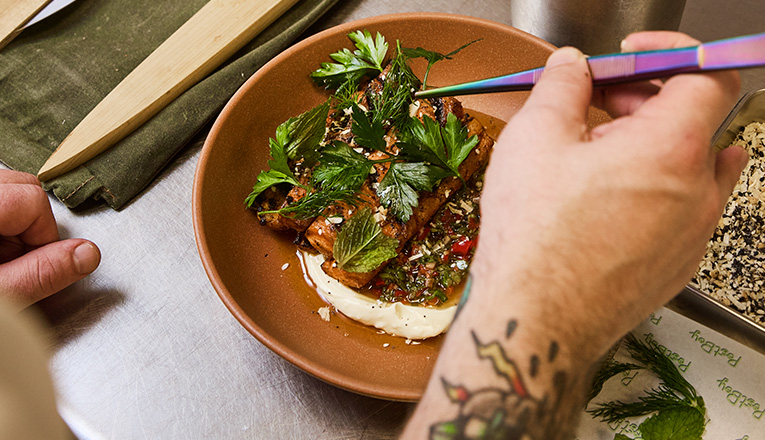
There are so many people involved in making a restaurant cool. Not just the chef. With the documentary, I wanted to put a spotlight on the craftspeople—to go inside their shops and show them making stuff with their hands. Because otherwise they’re behind the scenes.
Where did you gain an appreciation for craft?
My dad’s side of the family. My grandma did pottery, and so did my aunt. My grandpa and my dad were carpenters. My dad made boats and musical instruments in a shop in the basement. I’d help him sand and cut things when I was younger. He also built houses all around the area. So I have a lot of respect for people who create things with their hands.
How did the connection between cooking and creativity click for you?
I needed a job, so I started cooking. It wasn’t a creative expression at that time. It wasn’t until my daughter came into the world when I said, ‘I’d better find a career.’ I started getting cookbooks, and I was like, ‘Oh, this is also art.’ So I found the best restaurant in town, which was Bread+Bar in Benton Harbor, and the [late] owner, Tim Foley, took me under his wing. Then I really got passionate about cooking.
People tend to get passionate about stuff they’re inherently good at. And I found I had a knack for it. I was like, ‘Oh, I can get paid for this and enjoy this.’ That’s when I started taking the train to Chicago and doing stages at all these nice restaurants. The more of those you get, the easier it is to get more. I staged in some Michelin-starred restaurants. After that, it was game on.
The restaurants you’ve opened—Houndstooth, Anemel, PostBoy—all have specific, carefully considered aesthetics. When did design become important to you?
It just happened organically. I’ve always been into interior design. Even in my 20s, living in my apartment, I was always painting walls, playing with lighting.
Houndstooth, Anemel [now closed], and PostBoy are all completely different, vibe-wise. I wanted to make sure they weren’t alike at all, and that each had a whole different expression.
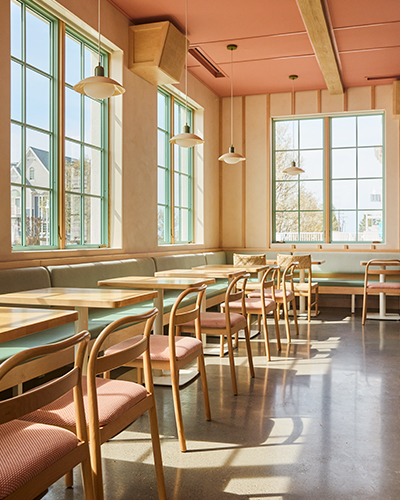
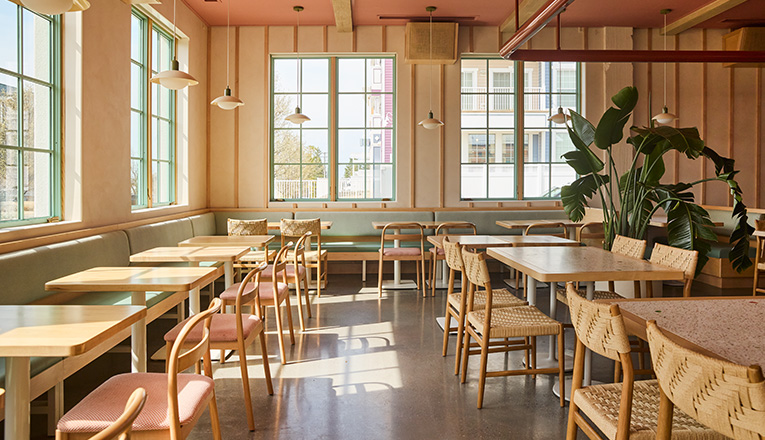
The name PostBoy comes from a mail ship that wrecked in Lake Michigan, and so many beach towns have restaurants that lean into the nautical aspect. I didn’t want to do that. I wanted ‘Danish midcentury modern meets a diner.’ It’s still beachy, but it’s also minimal and sleek. Breeze blocks. No art on the walls. Retro speakers. Simple and architectural.
Beyond how it looks, what do you want the experience to be like?
Very, very inclusive. I hope everyone thinks it’s a place for everyone.
The ethos of the food is ‘Midwest approachable, with a global twist.’ We start with Midwest comfort foods, nostalgic foods, and see what other flavors we can pull in. I have a big table full of cookbooks and will go down Google rabbit holes and realize that another country has a similar version of a Midwestern flavor, and we’ll try it.
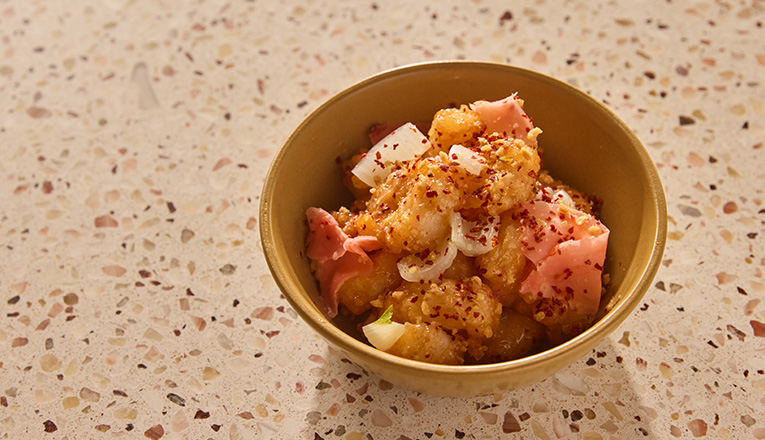
For instance, on our brunch menu, we have Japanese pancakes with matcha butter and brown-sugar syrup. Because in Japan, they use a brown-sugar syrup instead of maple syrup. When we first opened, we had gnocchi on the menu with citrus cream, tossed in a cheddar Mornay sauce with bacon and chives. That’s everything in a loaded baked potato, but it’s gnocchi.
So when we talk about approachability, what does that mean? To me, it’s finding points of recognition—not dumbing something down. Helping people see, ‘Whoa, this tastes just like this.’
It also falls on the service staff to teach on a lateral level without any pretense. Because I’m not a white tablecloth kind of person. On our menu, there’s also a lot of high-low. Putting junk food in something fancy is, like, my favorite thing. We use Cheez-Its for crunch on our Caesar salad. And it’s literally Cheez-Its. At first we were like, ‘Okay, how do we make our own?’ Then, ‘Why are we making Cheez-Its? We are not gonna make them better.’
In PostBoy’s second summer, what’s new?
In a restaurant’s first year, it can sometimes feel like death by a thousand cuts—a bunch of small things that make it either really easy or really difficult. This year, we’re in a better flow.
We started to R and D our summer menu a lot earlier. And we know how much staff we need. Last year, we didn’t have quite enough people. This summer we have a lot of the same staff, who can now train others. We also built a cool vestibule outside, so we’re able to serve on the patio even in the rain.
How close is PostBoy to becoming what you envisioned?
A building or restaurant or piece of art shows you what it is. It starts growing on its own. And now this place has a heartbeat. It just takes a lot of intention. I still think we could do better. We definitely have more ideas. We’re still babies.
PostBoy
207 N Whittaker St
New Buffalo, MI
words Lena Singer
images Lucy Hewett
May 2026
Interview edited for length and clarity.